

Independent review
Capital on Tap Business Credit Card Review
An independent Capital on Tap business credit card review: who gets approved, how the credit line and rewards work, plan fees, interest, the personal guarantee question, and when a business card is the wrong answer.
Last reviewed:
Published:
Our verdict
Best for
UK limited companies and eligible LLPs with predictable monthly spend, a habit of clearing the balance in full, and a director willing to accept the guarantee terms on offer.
Look elsewhere if
Sole traders (not normally accepted), businesses already struggling to pay suppliers or HMRC, and anyone planning to carry a balance month to month.
Capital on Tap at a glance
- Product
- Business credit card with a revolving credit line and a rewards programme
- Who can apply
- Active UK Ltd, LLP or PLC listed at Companies House; applicant must live in the UK and be an active director or a majority shareholder owning at least 25%
- Sole traders
- Not eligible
- Trading history and turnover
- No minimum: eligible businesses of any age can apply
- Application credit search
- Personal-file soft search only; no visible business-file hard search at application
- Cost
- Plan fees may apply; interest applies to balances not cleared in full
- Personal guarantee
- Required from a director or majority shareholder under Capital on Tap's current terms
- Cards
- Multiple employee cards with individual limits
What the product is, in plain English
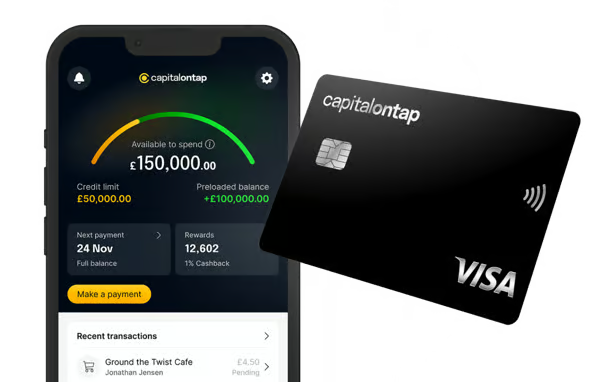
Capital on Tap gives eligible UK companies a business credit card with a revolving credit limit and a points-based rewards programme. You spend on the card, you get a statement, and you either clear it in full or carry a balance and pay interest.
It is a credit product from a lender, not a bank account and not free money. The rewards are the marketing; the credit line and the terms attached to it are the product. Judge it on the terms.
Who actually gets approved
The business must be an active UK-registered private limited company (Ltd), limited liability partnership (LLP) or public limited company (PLC), listed as active at Companies House. The applicant must reside in the UK and be an active director or a majority shareholder who owns at least 25% of the business. The applicant and business must have no unsatisfied CCJs in the last 12 months. Sole traders are not eligible.
There is no minimum trading history and no minimum turnover: eligible businesses of any age can apply. Approval is still not guaranteed: Capital on Tap makes its own status, credit and eligibility decision.
At application, there is no visible hard search on the business credit file. Capital on Tap runs a standard soft search on the applicant's personal file; it does not affect the personal credit score and is not visible to other lenders. A hard search of the business credit file happens later, only when the credit agreement is signed, and it can then be visible to other lenders.
For an otherwise eligible business, the absence of a business-file hard search at application removes a potential reason not to apply. That does not remove the need to consider the later hard search before signing the credit agreement.
- Confirm that Companies House lists the business as active and that the legal entity is an eligible Ltd, LLP or PLC.
- Confirm that the applicant lives in the UK, is an active director or an eligible 25%+ shareholder, and that neither applicant nor business has an unsatisfied CCJ in the last 12 months.
- Do not self-exclude merely because the business is new or has low turnover; those are not stated minimums.
- Before signing, factor in the later business-file hard search as well as the personal guarantee and repayment obligation.
The credit line: how to think about the limit
A credit limit is not working capital and it is not a cash buffer. It is short-term borrowing that must be repaid, and the amount you are offered reflects what the lender thinks you can service — not what your business can safely afford.
The healthy pattern is simple: put spend you were already making on the card, clear it in full every month, and treat the limit as a payment-timing tool rather than funding. The unhealthy pattern is using the limit to bridge a gap you cannot see the end of. That is how a card becomes a permanent, expensive debt.
Rewards: worth having, not worth chasing
Points accrue on spend and can be redeemed under the current rewards terms. On genuine business spend that you clear monthly, rewards are a real if modest benefit. Two things kill that benefit: carrying interest, and spending more than you would have because points are on the table.
Do the arithmetic honestly. If a month of interest on a carried balance is larger than a year of points, the rewards are a distraction. In almost every scenario where a business carries a balance, that is exactly what happens.
Fees and interest: the numbers that matter
Depending on the plan chosen, a card fee may apply. Capital on Tap states that card purchases can receive up to 42 days' interest-free credit on card purchases, subject to the statement cycle and paying the balance in full by the due date. Interest applies to balances not repaid in full by the due date. Foreign exchange charges, late payment fees and cash-type transaction charges can also apply, and cash-type transactions are usually the most expensive way to use any credit card.
Rates as low as 13.86% APR (variable). Interest rates are variable. Approval is subject to status and T&Cs.
The personal guarantee question
Capital on Tap currently requires a personal guarantee from a director or majority shareholder. This means that person can become personally liable for the business's outstanding debt if the business cannot repay it. Read the current product terms before applying. That converts a company debt into a personal one, and limited liability stops protecting you for that amount.
Read the guarantee wording on the application itself, not a summary. If you are not comfortable being personally liable for the full limit in a bad month, either ask for a lower limit or do not take the product.
When a business credit card is the wrong answer
If the reason you want a card is that you cannot pay a supplier or an HMRC bill this month, the card is not the fix. It moves the problem forward and adds interest to it. The better moves are a payment plan with HMRC, a conversation with the supplier, chasing your own overdue invoices, and free debt advice if the pressure is real.
This is also why the reader offer for this product is suppressed on our cash-flow-crisis and insolvency pages. A rewards promotion has no business appearing next to guidance for someone who cannot make payroll.
- You cannot say with confidence how you will clear the balance next month.
- You are already using personal credit to fund the business.
- The limit would be used mainly for cash-type transactions.
- You are in or approaching a formal insolvency process.
Alternatives worth comparing first
A business charge card that must be cleared monthly removes the temptation to carry debt. A negotiated supplier credit account often costs nothing. Invoice finance can be a better structural answer to late payment than a card. And for genuine growth investment, a term loan with a fixed repayment schedule is usually cheaper and more honest about what it is.
The card wins on convenience, employee cards and rewards. It loses badly to almost everything else if you are going to carry a balance.
Strengths and limitations
What works well
- Revolving limit that smooths payment timing for a profitable company
- Multiple employee cards with individual limits and visible spend
- Rewards points on spend you were making anyway
- Application and account management are quick and app-based
- Useful spend controls and export for bookkeeping
Limitations
- Sole traders are not normally accepted
- Approval subject to status, credit checks and affordability — never guaranteed
- Interest and fees can easily outweigh reward points
- A personal guarantee from a director or majority shareholder can expose that person personally
- Missed payments can affect business and personal credit files
- Cash-type transactions are expensive and may not earn rewards
How it compares
| Option | Best for | Main cost | Main risk |
|---|---|---|---|
| Business credit card | Regular spend cleared monthly | Plan fee, interest if carried | Interest spiral, personal guarantee |
| Charge card | Discipline — must clear monthly | Annual or monthly fee | No flexibility if cash is tight |
| Supplier credit account | Stock and materials | Often free | Relationship damage if you pay late |
| Invoice finance | Late-paying B2B customers | Percentage of invoice value | Cost per invoice adds up quickly |
| Term loan | Planned investment | Fixed interest | Fixed repayments regardless of trading |
This review covers a credit product
Frequently asked questions
- Who is eligible for a Capital on Tap business credit card?
- The business must be an active UK-registered Ltd, LLP or PLC listed as active at Companies House. The applicant must live in the UK and be an active director or a majority shareholder owning at least 25%. Neither the applicant nor the business can have an unsatisfied CCJ in the last 12 months. There is no minimum trading history or turnover, so eligible businesses of any age can apply. Sole traders are not eligible, and Capital on Tap still makes the final status, credit and eligibility decision.
- Does Capital on Tap require a personal guarantee?
- Capital on Tap currently requires a personal guarantee from a director or majority shareholder. This means that person can become personally liable for the business's outstanding debt if the business cannot repay it. Read the current product terms before applying.
- Does applying affect my credit score?
- At application, Capital on Tap runs a standard soft search on the applicant’s personal file. It does not affect the personal credit score and other lenders cannot see it; there is no visible hard search on the business credit file at that point. A hard business-file search happens later only when the credit agreement is signed, and it can then be visible to other lenders. The initial search therefore removes a potential reason for an otherwise eligible business not to apply, but the later search remains relevant before signing.
- What does the Capital on Tap card cost?
- The Free plan has no annual fee; the Pro plan costs £299 per year and includes enhanced rewards including 1.25% cashback on preloaded spend and 1:1 Avios conversion. Interest applies to any balance not repaid in full by the due date. Foreign exchange, late payment and cash-type transaction fees can also apply. Rates as low as 13.86% APR (variable). Interest rates are variable. Approval is subject to status and T&Cs.
- Are the reward points actually worth it?
- Only if you clear the balance in full every month and do not spend more because points are on offer. A single month of interest on a carried balance can wipe out a year of rewards.
- Is Capital on Tap good for a business with cash flow problems?
- No. If you are borrowing to cover a shortfall, a credit card adds cost to an existing problem. Speak to HMRC about a payment plan, chase your overdue invoices, and get free advice from Business Debtline before taking on more credit.
- Can I get a Capital on Tap card as a sole trader?
- Not normally. The product is aimed at limited companies and eligible LLPs. Sole traders generally need a different product.
Sources
- Capital on Tap — official product and eligibility information
- Capital on Tap — up to 42 days of interest-free credit
- Capital on Tap — eligibility and personal guarantee information
- FCA — Financial Services Register
- Business Debtline — Free debt advice for small businesses
- GOV.UK — If you cannot pay your tax bill on time
Update log
- Eligibility, no-minimum trading-history and turnover criteria, and application-versus-signed-agreement credit-search timing checked and updated.
- Full review published, including personal guarantee, fee and interest risk wording checked against the lender's published terms.


Who wrote and checked this
Written by Daniel Mercer, who has run the numbers on his own small business and writes from that experience. Daniel is not an accountant or a regulated financial adviser. Who writes this site.
Peer reviewed by Marcus Thorne, Small Business Advisor. Peer reviewers check for technical accuracy and compliance with current UK regulations.
Last reviewed: 18 September 2026
Do this next
Next steps after this Capital on Tap review
- 1
Check a card is the right tool
Two minutes of questions that will tell you plainly if borrowing is the wrong answer right now.
Run the check - 2
Understand the wider decision: Business Spending
Control what leaves the account, and know why it left.
Open the hub - 3
See the Capital on Tap offer terms in full
Code, qualifying steps, exclusions, fees and the date we last checked them.
View the terms
Keep reading
Related guidance
Independent guidance that puts the Capital on Tap decision in context.