

Independent review
Tide Business Account Review
An independent Tide business account review for UK sole traders and limited companies: plan fees, transfer and cash deposit charges, what onboarding is like, where it falls short, and who should choose something else.
Last reviewed:
Published:
Our verdict
Best for
Sole traders, freelancers and small limited companies paid by bank transfer or card, who want fast onboarding and light bookkeeping built into the account.
Look elsewhere if
Cash-heavy businesses, anyone who needs branch banking or a relationship manager, and companies that want borrowing, FX and banking from one incumbent provider.
Tide at a glance
- Account type
- Business current account from an e-money and banking services provider
- Who can open one
- UK sole traders, limited companies and eligible partnerships
- Opening time
- Typically same day to a few days, subject to identity and business checks
- Plans
- Free plan plus paid tiers with larger included allowances
- Typical charges
- Per-transfer, cash deposit and ATM fees depending on plan
- Built in
- Invoicing, expense categorisation, multiple team cards, accounting integrations
- Support
- In-app and online; no branch network
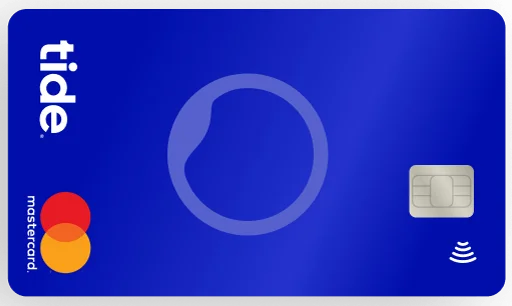
What Tide actually is
Tide provides the platform and business-banking services to UK small businesses. For new Tide sign-ups, the underlying business account is provided by ClearBank. That distinction matters for two practical reasons: how your money is protected, and who you speak to when something goes wrong.
For day-to-day use the difference is invisible. You get an account number and sort code, Faster Payments in and out, Direct Debits, a business card and a mobile app. Where it becomes visible is in edge cases: paying in cash, disputing a large payment, or asking for an overdraft on a Friday afternoon.
For new Tide sign-ups, Tide says the business account is provided by ClearBank. Eligible deposits held with ClearBank are FSCS-protected up to a total of £120,000, subject to the FSCS eligibility rules. The limit is per eligible depositor, per authorised firm and can combine eligible balances held with ClearBank through Tide and any other ClearBank accounts. A sole trader is treated in the individual or sole-trader category for FSCS purposes, so do not assume a separate personal and sole-trader limit at the same authorised firm. Tide is the platform and service provider; ClearBank provides the underlying business account. Savings products can have a different provider and protection arrangement, so check the provider named in the product terms before depositing. Provider arrangements, eligibility rules and compensation limits can change. Recheck Tide's current safety page and the FSCS checker before depositing a material balance.
Opening an account: what onboarding is like
Onboarding is done in the app. You provide identity documents, business details and, for a limited company, the company number and details of directors and people with significant control. Most straightforward applications clear quickly; anything unusual — a recently incorporated company, an overseas director, a high-risk trade sector — takes longer or is declined.
The realistic expectation is same day to a few days. Do not book your first supplier payment on the assumption the account will be live tomorrow.
- Have your photo ID and proof of address ready before you start.
- Limited companies: make sure Companies House details are current, especially the registered office and PSC register.
- Use the business name exactly as registered, not the trading name you use on Instagram.
- If you are switching, keep the old account open until every Direct Debit and standing order has moved.
Fees: where the money actually goes
Tide's headline is a free plan. That is genuinely free to hold, but individual actions can carry charges, and the paid plans exist because heavier users hit those charges. The three costs that catch small businesses out are per-transfer fees on the free plan, cash deposit fees at Post Office or PayPoint, and ATM withdrawal fees.
Work out your monthly volume before choosing a plan. If you make 60 transfers a month, a paid plan with included transfers is usually cheaper than paying per item. If you make six, the free plan is fine. This is a five-minute calculation and it is the single biggest lever on what Tide costs you.
Always check the current fee schedule on Tide's own site. Fees change, and a review page is not the source of truth for pricing.
Day-to-day use: the app, cards and payments
The app is the product. Payments are quick, notifications are instant, and you can issue expense cards to team members with their own limits — useful the moment someone other than you starts buying things.
Transactions can be categorised and receipts attached at the point of spend. If you have ever spent an evening in February matching card receipts to a bank statement, that feature alone changes your relationship with bookkeeping.
Invoicing is built in. You can raise an invoice, send it, and match the payment when it lands. For a freelancer or a small services business this removes a separate tool and a separate subscription. For a business with complex VAT, stock or project accounting, it will not replace proper accounting software.
Cash handling: the biggest weakness
If your customers pay you in cash, read this section twice. Cash deposits go through Post Office or PayPoint and carry a fee per deposit, usually a percentage or a flat charge depending on the route. Take £400 in cash a week and those fees add up to a real number over a year.
There is no branch to walk into with a bag of coins. For a market trader, a barber or a café, that alone may rule Tide out in favour of a traditional bank with cash facilities — or make a hybrid arrangement sensible, with a high-street account for cash and Tide for everything else.
Support: what happens when something breaks
Support is in-app and online. On paid plans you generally get faster routes to a human. There is no branch and no named manager on the standard tiers.
In practice, most queries are routine and get resolved. The scenario worth thinking about in advance is an account restriction — a compliance review that freezes payments while it runs. It is rare, it happens across the industry, and the only sensible protection is not keeping every penny of your operating cash with one provider. Keep a second account somewhere else with enough in it to cover payroll and one month of essentials.
Accounting integrations and reporting
Tide connects to the mainstream accounting packages, so transactions flow into your books without CSV gymnastics. Categorisation in the app carries useful context across, which cuts the monthly reconciliation job substantially.
Reporting inside Tide is transactional rather than managerial: it tells you what happened, not whether your pricing works. Pair it with a proper look at your numbers once a month — that is what the tools on this site are for.
How much of your money should sit there?
This is a judgement call, not a rule. The sensible approach for any non-branch provider is to keep working capital in the account you transact from, and to hold tax reserves and any meaningful surplus somewhere separate — ideally with a different provider, so a single restriction or outage cannot stop you paying HMRC.
Separating tax money from trading money is good practice regardless of who you bank with. It is the single habit that prevents most of the January panics we write about.
Strengths and limitations
What works well
- Fast, app-based onboarding for straightforward UK businesses
- Free plan that is genuinely free to hold
- Invoicing and expense categorisation built into the account
- Team expense cards with individual limits
- Clean integrations with mainstream accounting software
- Multiple sub-accounts, which makes tax reserving easy to actually do
Limitations
- Cash deposits cost money and rely on Post Office or PayPoint
- No branches and no relationship manager on standard tiers
- Per-transfer fees on the free plan can outweigh a paid plan for busy accounts
- Account provided by ClearBank; eligible deposits are currently FSCS-protected up to £120,000, subject to eligibility and aggregation rules
- Lending options are narrower than a full-service incumbent bank
How it compares
| Requirement | Tide | App-first alternative | High-street bank |
|---|---|---|---|
| Speed to open | Usually days | Usually days | Often longer, more paperwork |
| Cash deposits | Post Office / PayPoint, fees apply | Similar, fees apply | Branch and cash centre facilities |
| Monthly cost | Free plan available; paid tiers for volume | Free or low-cost tiers common | Often free intro period, then monthly fee |
| Invoicing built in | Yes | Varies | Rarely |
| Human support | In-app; faster on paid plans | In-app | Phone and branch, sometimes a manager |
| Borrowing | Limited range via partners | Varies | Broadest range |
Frequently asked questions
- Is Tide a real bank?
- For new Tide sign-ups, Tide says the business account is provided by ClearBank. Eligible deposits held with ClearBank are FSCS-protected up to a total of £120,000, subject to the FSCS eligibility rules. The limit is per eligible depositor, per authorised firm and can combine eligible balances held with ClearBank through Tide and any other ClearBank accounts. A sole trader is treated in the individual or sole-trader category for FSCS purposes, so do not assume a separate personal and sole-trader limit at the same authorised firm. Tide is the platform and service provider; ClearBank provides the underlying business account. Savings products can have a different provider and protection arrangement, so check the provider named in the product terms before depositing. Provider arrangements, eligibility rules and compensation limits can change. Recheck Tide's current safety page and the FSCS checker before depositing a material balance.
- Is the Tide business account free?
- There is a free plan that costs nothing to hold. Individual actions such as transfers on the free plan, cash deposits and ATM withdrawals can carry fees, and paid plans bundle larger allowances. Work out your monthly volume before choosing a plan.
- Can sole traders open a Tide account?
- Yes. Tide accepts UK sole traders as well as limited companies and eligible partnerships, subject to its identity and business checks.
- How long does it take to open a Tide account?
- Straightforward applications are often approved the same day or within a few days. Recently incorporated companies, overseas directors and higher-risk sectors take longer or may be declined.
- Can I pay cash into a Tide account?
- Yes, through Post Office or PayPoint, but each deposit carries a fee. If you take cash regularly, price that up over a year — it is the main reason a cash-heavy business might prefer a bank with branch facilities.
- Does Tide work with accounting software?
- Yes. Tide integrates with the mainstream UK accounting packages, and the categories and receipts you add in the app carry across, which cuts reconciliation time.
- Is Tide worth switching to?
- If you are paid electronically and want faster onboarding, built-in invoicing and cheaper day-to-day running costs than a legacy account, yes. If you handle cash, need branch support or want borrowing from the same provider, a high-street bank is likely the better fit.
Sources
Update log
- Full review published, with plan fees, cash handling and support checked against Tide's published terms.


Who wrote and checked this
Written by Daniel Mercer, who has run the numbers on his own small business and writes from that experience. Daniel is not an accountant or a regulated financial adviser. Who writes this site.
Peer reviewed by Sarah Chen, Chartered Accountant (FCA). Peer reviewers check for technical accuracy and compliance with current UK regulations.
Last reviewed: 9 August 2026
Do this next
Next steps after this Tide review
- 1
Check the account fits how you get paid
Cash handling, transfer volumes and integrations decide this more than the sign-up reward.
Find your fit - 2
Understand the wider decision: Business Banking
Clean separation, clean records, fewer surprises at year end.
Open the hub - 3
See the Tide offer terms in full
Code, qualifying steps, exclusions, fees and the date we last checked them.
View the terms
Keep reading
Related guidance
Independent guidance that puts the Tide decision in context.